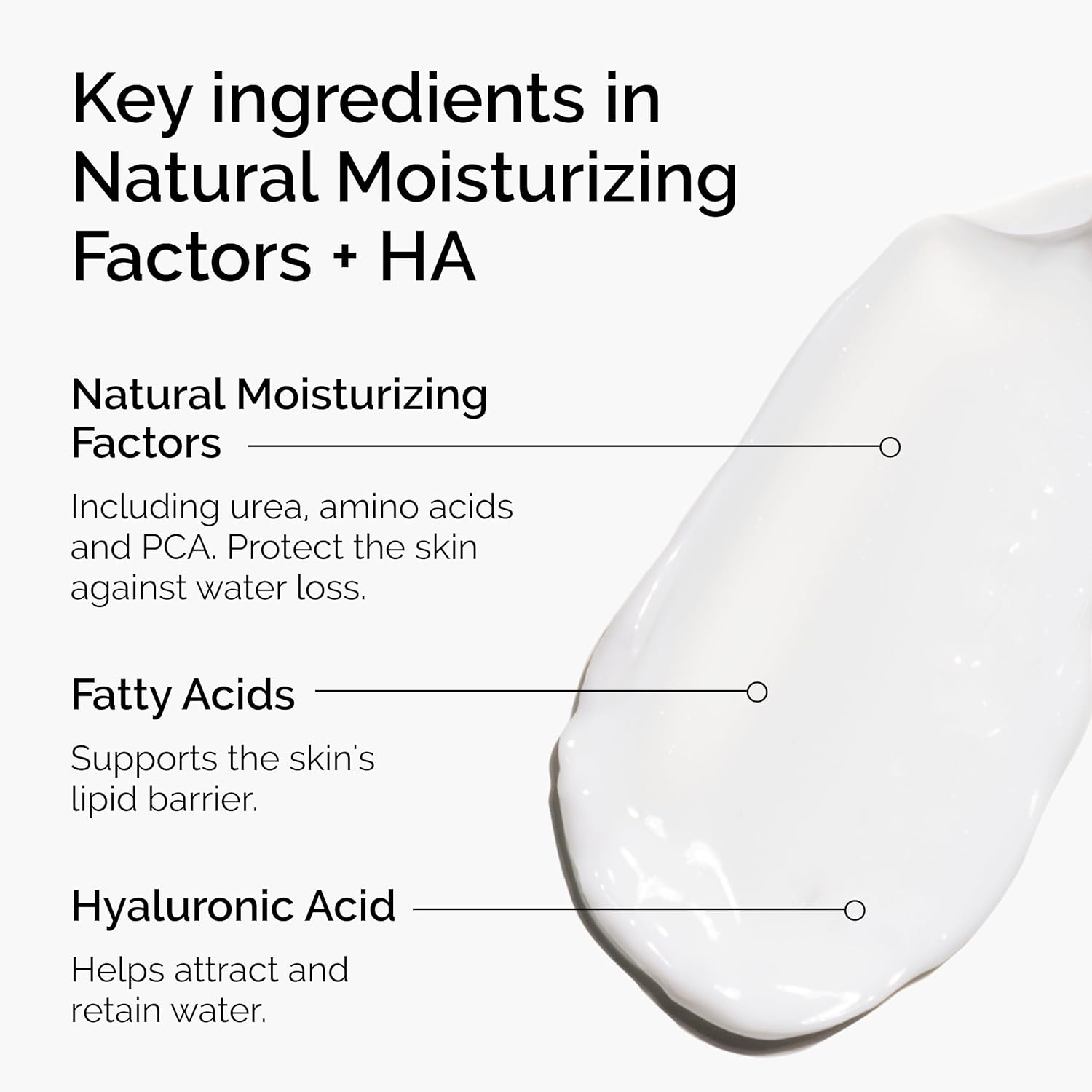
If you’ve ever stood in front of The Ordinary’s wall of products and wondered whether you need the one that says “NMF + HA,” the one that says “NMF + PhytoCeramides,” or the one that says “NMF Amino Acids + Urea” — you’re not alone, and the confusion is reasonable. NMF stands for Natural Moisturizing Factors, which is simply the collective name for the water-binding compounds your skin already makes on its own — things like amino acids, urea (a gentle softening agent your body produces naturally), and sodium PCA (a salt derived from the amino acid proline that holds moisture in the outer skin layer). When your skin barrier is compromised — by weather, over-exfoliation, aging, or just genetics — these compounds deplete, and replenishing them topically is one of the most evidence-backed approaches to lasting hydration. The Ordinary built a small product family around NMF, all priced under $20. That’s the good news. The less obvious news: these aren’t interchangeable formulas. Each one targets a meaningfully different skin concern, and buying the wrong one means either getting nothing your skin needs or doubling up on actives you’re already getting elsewhere. This guide decodes all three — side by side, with the math — so you can make a confident call.
The Three Formulas, Plainly Stated
Before diving into comparisons, it helps to name each product clearly. The Ordinary currently offers:
- Natural Moisturizing Factors + HA — the original, water-phase humectant formula with hyaluronic acid (HA) and a broad NMF complex including amino acids, sodium PCA, and glycerin.
- Natural Moisturizing Factors + PhytoCeramides — a lipid-enriched evolution that layers barrier-restoring plant-derived ceramides (fats that seal the skin’s protective layer) on top of the NMF base.
- Natural Moisturizing Factors Amino Acids + Urea — a targeted repair formula leaning heavily on urea as a keratolytic (a softening agent that loosens dead skin cell bonds) alongside a refined amino acid profile.
All three share a foundational NMF scaffold. The differences live in what each formula adds to that scaffold — and those additions change the clinical use case considerably.
INCI Decoded: What Each Formula Is Actually Doing
Formula 1: NMF + HA
The INCI list for the original NMF + HA reads like a textbook on transepidermal water loss (TEWL) prevention. According to CosDNA’s breakdown and Deciem’s own ingredient disclosures, the top actives include sodium PCA, glycine, alanine, serine, and sodium hyaluronate — a lower-molecular-weight form of hyaluronic acid that draws moisture from the environment into the upper skin layers.
What this formula does well: it is exceptionally lightweight and texturally neutral. Reviewers at Byrdie consistently describe it as absorbing without residue, making it a reliable base layer under facial oils, SPF, or richer creams. For combination and oily skin types, this is frequently the NMF formula that works best as a standalone hydrator, because it doesn’t add any lipid content — just water-binding agents.
What it doesn’t do: it won’t repair a compromised lipid barrier on its own. Hyaluronic acid draws moisture in, but without an occlusive or a ceramide layer, that moisture can escape back out — a phenomenon well-documented in dermatology literature and cited in EWG Skin Deep’s overview of humectant mechanisms. If your skin feels tight an hour after applying HA-based products, this is likely the dynamic at play.
Best fit: oily, combination, or normal skin; layering under heavier formulas; hot-weather routines; anyone who already has a barrier-repair element elsewhere (a ceramide moisturizer, a squalane oil, or a dedicated occlusive).
Formula 2: NMF + PhytoCeramides
This is the formula that takes the biggest compositional step forward. PhytoCeramides are plant-derived ceramide analogs — according to INCIDecoder’s ingredient profile pages, they function similarly to the ceramides naturally found in the stratum corneum (the outermost skin layer), helping to plug gaps in the lipid matrix that holds skin cells together.
The practical difference is felt texturally and mechanically. Reviewers at Allure’s 2025 roundup of The Ordinary’s best products noted that the PhytoCeramides version has a slightly creamier, more emollient (skin-softening) feel compared to the original — still lightweight by most standards, but with a degree of slip that the first formula lacks. This makes it more comfortable as a standalone moisturizer for dry or dehydrated skin types, particularly in cold or low-humidity climates.
Ingredient-literacy note: “PhytoCeramides” is a marketing-umbrella term. The actual INCI listing will show compounds like ceramide NP or plant-derived fatty acid precursors depending on the batch — Deciem’s ingredient disclosures confirm this variation. That’s not a red flag, but it does mean this formula is less predictable than a straight ceramide concentrate from a brand that names ceramide NP, AP, and EOP explicitly.
Best fit: dry to normal skin; barrier-depleted skin recovering from over-exfoliation or seasonal stress; anyone whose routine lacks a ceramide source; transitional weather routines.
Formula 3: NMF Amino Acids + Urea
This is the most functionally specific of the three — and the one most likely to be misread as a simple moisturizer when it’s actually doing something different. Urea at the concentrations used in skincare (typically 2–10%) is a humectant and a keratolytic, meaning it both draws water into the skin and chemically loosens the bonds between dead skin cells, improving surface texture over time. EWG Skin Deep rates urea at a low hazard score and notes its established use in clinical dermatology for conditions including xerosis (chronic dryness) and ichthyosis.
At the concentrations The Ordinary uses in this formula — estimated in the 5% range based on typical placement in the INCI list and Deciem’s general formulation transparency — urea functions more as a humectant than as a strong exfoliant, but regular users do report improved skin smoothness over weeks of use. This is consistent with urea’s established mechanism at low-to-mid concentrations, as documented in dermatological literature and reviewed in sources like Allure’s ingredient education content.
The amino acid profile in this formula is also narrower and more targeted than in the NMF + HA version — less about broad humectant coverage, more about signaling support for natural desquamation (the skin’s own shedding process).
Best fit: rough, congested, or texture-heavy skin; keratosis pilaris (KP, a common condition causing bumpy skin on arms, thighs, or cheeks); skin that doesn’t respond well to purely aqueous hydrators; body use as well as face.
By the Numbers
| Formula | Price (30mL) | Price per mL | Key differentiator | Best skin type |
|---|---|---|---|---|
| NMF + HA | ~$8–10 | ~$0.28–0.33 | Lightweight; water-binding only | Oily / combination |
| NMF + PhytoCeramides | ~$10–12 | ~$0.33–0.40 | Lipid-layer support added | Dry / dehydrated |
| NMF Amino Acids + Urea | ~$8–10 | ~$0.28–0.33 | Keratolytic + humectant; texture-improving | Rough / congested |
Pricing based on Deciem’s US retail as of May 2026. Cost-per-use assumes a 0.25mL facial application twice daily — roughly 60 uses per 30mL tube, or about $0.14–$0.20 per use across all three options.
The Stacking Question: Can You Use More Than One?
Yes — with intention. The most commonly cited combination among reviewers at Byrdie and in Allure’s coverage of The Ordinary routines is NMF + HA underneath NMF + PhytoCeramides: the first formula floods the skin with water-binding agents, and the ceramide formula helps seal that hydration in. That’s a functionally sound layering logic, not just marketing.
What doesn’t stack cleanly: NMF Amino Acids + Urea alongside an active exfoliant (AHA, BHA, or prescription retinoid). Urea increases skin cell turnover on its own; pairing it with another chemical exfoliant can compromise the barrier rather than support it. INCIDecoder’s formulation notes flag this as a timing consideration rather than a hard contraindication — morning use of the urea formula and evening use of actives is the workaround most commonly recommended by estheticians in professional formulation discussions.
The Decision Rule
If your skin is oily, combination, or already has a ceramide source in your routine: NMF + HA is the logical pick. It’s the most versatile formula, the lowest barrier to entry, and at under $10 for a 30mL tube the cost-per-use math is essentially a non-issue.
If your skin is dry, dehydrated, or you’re recovering from barrier damage (over-exfoliation, harsh winter air, post-procedure sensitivity): NMF + PhytoCeramides earns its place as a standalone, especially if you don’t have a dedicated ceramide moisturizer. The slight premium over the original is justified by what it adds.
If you’re dealing with texture, roughness, KP, or skin that feels perpetually dull despite adequate hydration: NMF Amino Acids + Urea is the one doing work the other two can’t replicate. It’s worth treating it as a targeted treatment, not just a moisturizer — apply it consistently for 4–6 weeks before evaluating results, which aligns with the skin cell turnover cycle.
The honest summary: The Ordinary’s NMF trio is unusually well-differentiated for a brand at this price point. None of these is a filler SKU. The error most shoppers make isn’t buying the wrong one — it’s buying one without understanding what the others are designed to do. Now you know.
Disclosure: This article contains affiliate links. If you purchase through a link on this page, naturalmoisture.com may earn a commission at no additional cost to you. Our editorial recommendations are independent of any affiliate relationship.