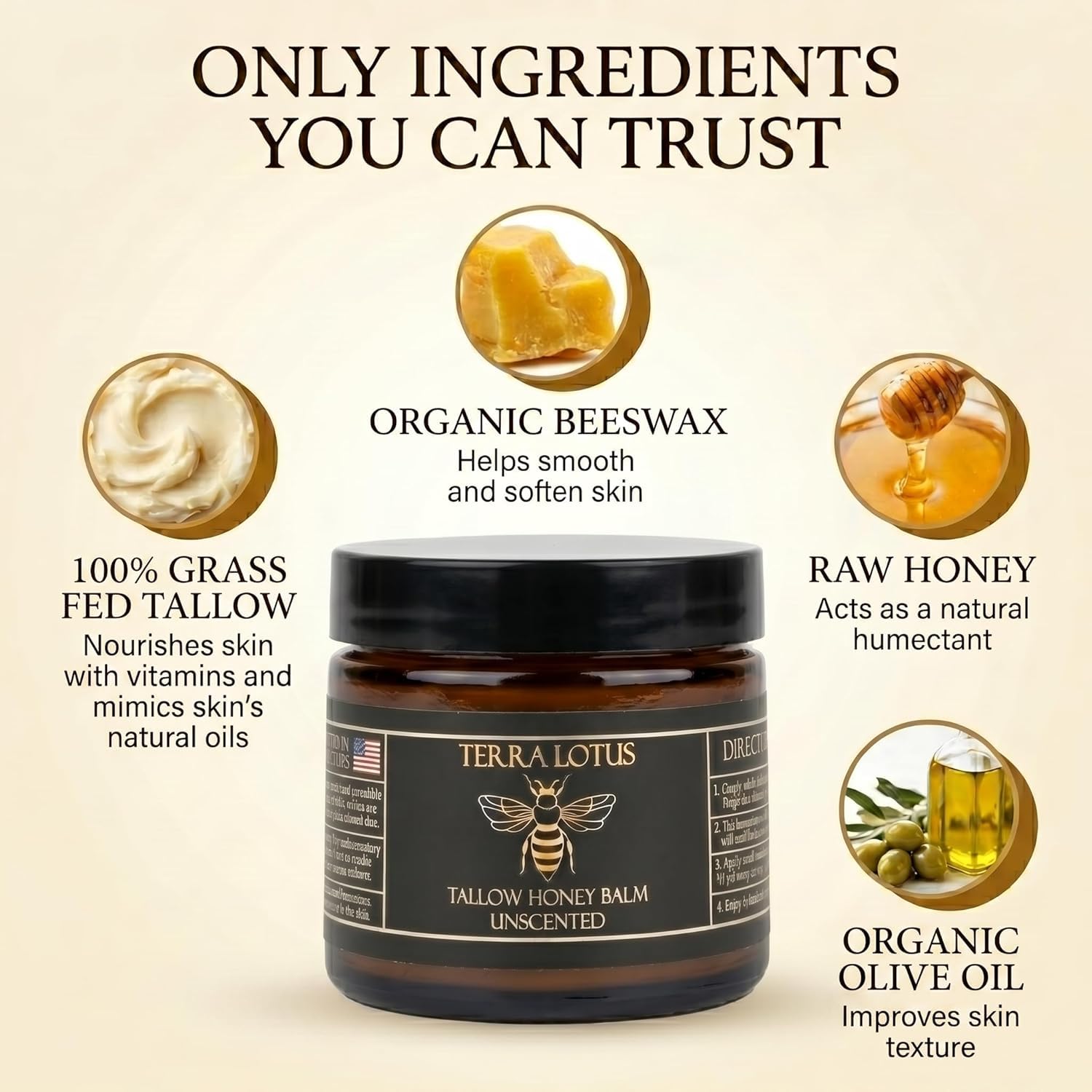
Imagine you’re standing in a small-batch skincare shop — or more likely, scrolling a boutique brand’s product page at midnight — and you see a little two-ounce tin of “grass-fed beef tallow balm” priced somewhere between $28 and $85. The copy uses words like ancestral, biocompatible, and skin-identical lipids. Your ingredient-literate brain wants to evaluate the INCI list (the standardized ingredient roster, pronounced “IN-see,” required on every cosmetic sold in the U.S. and EU), but you’re not entirely sure what you’re looking at. Tallow — rendered fat from cattle — is either a brilliant return to pre-industrial skincare or a greasy gimmick wearing nostalgia as a marketing strategy, depending on who you ask.
This article is for the reader who’s moved past “does tallow work?” and into “what should the INCI list actually say, what does the research support, and how do I compare products honestly at the point of purchase?” We’ll break down the fatty-acid profile, flag the claims worth scrutinizing, and end with a clear decision framework — because at $40–$85 for two ounces, this is not an impulse-buy category.
| EDITOR'S PICKHearth & Homestead Whipped Beef… | Mid-tier[RICHGRAND Beef Tallow for Skin…](https://www.amazon.com/dp/B0DTQ8FGQX?tag=greenflower20-20) | Budget pick[ELBBUB Whipped Tallow Cream for…](https://www.amazon.com/dp/B0DWMZR8WD?tag=greenflower20-20) | |
|---|---|---|---|
| Key oils | Olive oil | — | — |
| Beeswax incl. | ✗ | — | ✓ |
| Honey incl. | ✗ | ✓ | ✓ |
| Calendula incl. | ✓ | — | — |
| Rose incl. | ✓ | — | — |
| Price | $29.97 | $21.99 | $12.59 |
| See on Amazon → | See on Amazon → | See on Amazon → |
What Tallow Actually Is — and What the INCI Should Say
On a properly labeled cosmetic, beef tallow appears as Adeps Bovis (Latin for “beef fat”) or occasionally Bos Taurus Fat — the latter you’ll see on some EU-formatted labels. If a product’s marketing leads with “grass-fed tallow” but the INCI reads mineral oil first and mentions no Adeps Bovis at all, that’s a red flag worth taking seriously. The EWG’s Skin Deep Cosmetics Database lists Adeps Bovis as a low-hazard ingredient with a limited but generally positive data profile; the CosIng (EU Cosmetics Ingredient Database) classifies its primary function as emollient and skin conditioning — nothing more exotic than that in regulatory terms.
Tallow’s appeal to the ingredient-literate crowd comes from its fatty acid composition. Published research on ruminant depot fat — summarized accessibly in Healthline’s overview of tallow nutrition, which draws on Journal of the American Oil Chemists’ Society data — puts the rough breakdown as:
By the numbers: approximate fatty acid profile of rendered beef tallow
| Fatty Acid | Type | Approx. % |
|---|---|---|
| Oleic acid (C18:1) | Monounsaturated | 40–50% |
| Palmitic acid (C16:0) | Saturated | 24–30% |
| Stearic acid (C18:0) | Saturated | 18–25% |
| Linoleic acid (C18:2, omega-6) | Polyunsaturated | 2–4% |
| CLA (conjugated linoleic acid) | Polyunsaturated | 0.5–2% |
The oleic acid content is the functional anchor — oleic is a penetration enhancer and a primary component of human sebum (the skin’s own oil), which is where “skin-identical” language originates. Palmitic and stearic acids contribute occlusion and barrier reinforcement. The CLA fraction, present in genuinely grass-fed animals at higher concentrations than grain-fed, has anti-inflammatory associations in dietary research; its topical relevance is real but modest, and INCIDecoder’s ingredient notes flag it as understudied in cosmetic application specifically.
The honest framing: tallow is a capable, mid-weight occlusive-emollient with a sebum-adjacent lipid profile. The “biocompatible” claim has reasonable scientific grounding. The “ancestral wisdom” framing is marketing — valid as context, not as clinical evidence.
Where “Grass-Fed” Does — and Doesn’t — Change the Formulation
This is the tradeoff most buyers gloss over, so let’s name it directly.
What grass-feeding genuinely affects:
- CLA content. Peer-reviewed nutrition research consistently shows that grass-finished ruminants have 2–5× higher CLA concentrations in their fat than grain-finished animals. If CLA’s topical anti-inflammatory effect is your reason for choosing tallow over, say, a comparable plant-based occlusive like shea butter, the grass-fed sourcing matters in principle.
- Omega-3 to omega-6 ratio. Again, grass-fed animals skew more favorable on this ratio — relevant to inflammation signaling, though topical absorption of these specific fractions is not well-characterized in cosmetic literature as of mid-2026.
- Oxidation stability. Interestingly, higher CLA and omega-3 content can reduce oxidative stability slightly compared to grain-fed tallow’s more saturated fat profile. This is why some formulators note that genuinely grass-fed tallow balms may have a shorter practical shelf life and benefit more from added antioxidants (vitamin E / tocopherol on the INCI).
What grass-feeding does NOT meaningfully change:
- The core oleic/palmitic/stearic backbone that drives the emollient performance. The difference in these fractions between grass-fed and grain-fed is small enough that the functional moisturization story is nearly identical.
- The absence of allergens, comedogenic risk, or sensitization potential. Tallow sits in the moderate-comedogenic range for acne-prone skin regardless of grazing method — more on this below.
Byrdie’s overview of tallow skincare notes that the “grass-fed” designation also functions as a signal of sourcing transparency and brand values — which matters to this audience but is separate from the efficacy question. Be clear in your own decision-making about which you’re paying for.
The practical implication: When comparing a $32 tallow balm that markets “grass-fed” with no third-party sourcing documentation against a $68 product from a brand with named farm partnerships and batch traceability, you are not comparing the same risk profile — even if the INCI lists look similar.
Reading the INCI List: Green Flags, Yellow Flags, and Outright Red Flags
Here’s the comparison-focused framework for evaluating any tallow balm INCI at the point of purchase:
Green flags — what a thoughtfully formulated tallow balm looks like
- Adeps Bovis listed first or second. Ingredients are listed in descending order of concentration. If tallow is the hero ingredient, it should dominate the list.
- Tocopherol (vitamin E) or rosemary extract (Rosmarinus Officinalis Leaf Extract) as a preservative-antioxidant. These protect the unsaturated fractions from going rancid and are appropriate for this formulation type.
- Short INCI overall. The best tallow balms tend to be 3–8 ingredients. Complexity is not a virtue here.
- Essential oils listed last and specifically named. Lavandula Angustifolia (lavender), Pelargonium Graveolens (rose geranium), or similar — fine as fragrance, but their position at the bottom of the INCI means you’re getting trace amounts. They’re cosmetic, not functional.
Yellow flags — requires a follow-up question
- Beeswax (Cera Alba) very high on the list. Beeswax is a legitimate hardening agent for tins/sticks, but if it outranks the tallow, the texture and occlusive profile shift significantly. Not wrong, but know what you’re buying.
- Coconut oil (Cocos Nucifera) as a primary carrier. Coconut oil is comedogenic for a meaningful segment of users and changes the skin-feel dramatically. Some tallow balm makers use it as an extender; ask whether the “tallow balm” is actually a tallow-coconut blend.
- “Fragrance” (Parfum) as a catch-all. Allure’s clean beauty glossary notes that undisclosed “fragrance” can encompass hundreds of potentially sensitizing compounds. Tallow balm buyers who are choosing this category partly for minimalism should see every fragrance component named.
Red flags — walk away or demand clarification
- Tallow appearing fourth or lower on the INCI. At that concentration, you’re buying a plant-oil balm with a tallow marketing story.
- No INCI list published at all. This is a compliance failure in the U.S. (FDA) and EU (EC Regulation 1223/2009). Small-batch brands are not exempt.
- “Rendered in small batches” with no sourcing specifics. This phrase has become the artisan-product equivalent of “all-natural” — meaningful only when backed by documentation. Ask for the farm name, region, or third-party certification.
Skin-Type Reality Check — Who This Category Actually Serves
This is where the ancestral-skincare narrative runs ahead of the evidence, and practitioners recommending products to clients need the honest breakdown.
Most likely to benefit:
- Dry to very dry skin types, especially those who find water-in-oil creams too light or who react to common emulsifiers like PEG compounds or polysorbates.
- Eczema-adjacent and compromised-barrier skin that responds well to pure occlusive-emollient approaches (similar to the logic behind Vaseline or a high-quality squalane). Owners of tallow balms in this category consistently report relief from tightness and flaking in winter months — a pattern that tracks with the oleic-heavy lipid profile.
- Fragrance-sensitive users, provided they select a genuinely unscented formulation (Adeps Bovis, Tocopherol, nothing else).
Proceed with caution or test slowly:
- Acne-prone or breakout-prone skin. Oleic-dominant oils and balms carry moderate comedogenic potential for susceptible individuals. The “sebum-identical” argument cuts both ways — if your skin already overproduces similar lipids, adding more occlusion to the equation can trigger congestion. INCIDecoder notes oleic acid’s comedogenic association directly in its ingredient profile.
- Oily or combination skin, particularly in humid climates or summer months. A 50% oleic occlusive is a heavy proposition for skin that doesn’t need barrier reinforcement.
Cost-per-use reality: A 2-oz tin of tallow balm at $55, used as a targeted facial treatment (not an all-over body balm), applied in pea-sized amounts, typically yields 90–120 applications for face-only use. That works out to roughly $0.46–$0.61 per use — competitive with mid-tier botanical balms from brands like Weleda or First Aid Beauty, and genuinely cheaper per application than most luxury face oils in the same price tier when used conservatively.
The Decision Rule: If X, Then Y
You’ve read the INCI. You know the category. Here’s where to land:
If the INCI leads with Adeps Bovis, includes tocopherol, names all fragrance components (or has none), and the brand can document grass-fed sourcing → this is a well-formulated product in the category. Evaluate it against your skin type and commit to a patch test on the jaw before full-face use.
If the tallow appears below third position, or beeswax and coconut oil dominate the list → you’re buying a blended balm with tallow as a marketing accent. It may still be a good product, but price it accordingly against other plant-based balms, not against a genuine tallow concentrate.
If there’s no INCI list, no sourcing documentation, and the brand relies entirely on “ancestral wisdom” language → pass. The ingredient-literate standard this audience holds is exactly what separates a considered purchase from an expensive experiment. The data isn’t there to justify the premium, and the compliance gap is itself a signal about how the brand operates.
The tallow category has real formulation merit and a coherent ingredient rationale. It also has more hype than evidence in some corners. That’s not a reason to avoid it — it’s a reason to read the label first.
This site earns a commission on purchases made through retailer links in our articles. This does not affect our editorial recommendations. We evaluate products based on published ingredient data, aggregated reviewer reports, and independent research — not brand relationships.